Digital transformation usually gets framed as a technology problem. You hear about AI, automation, analytics, and modernization. Tools take center stage. Strategy decks pile up. Execution slows.
In practice, transformation stalls long before advanced technology enters the picture. The real blocker shows up earlier, quieter, and messier. Data spreads across systems. Ownership blurs. Access grows inconsistent. Trust erodes. Teams spend more time managing work than moving it forward.
Google Workspace sits at the center of that reality for many organizations. Email, files, identity, collaboration, and access all live there. Governance determines whether that environment supports transformation or quietly works against it.
Governance Determines Whether AI Can Deliver Value
AI depends on data that people trust. That trust doesn’t appear automatically. It comes from consistency, visibility, and control.
When governance falls behind, data chaos takes over. Files sprawl across Drives. Sharing rules drift. Accounts linger long after employees leave. Sensitive information spreads without clear accountability. AI tools inherit those problems immediately.
Poor data quality blocks growth. AI systems trained or grounded in unreliable data produce unreliable outputs. Teams stop trusting recommendations. Leaders hesitate to expand use cases. Momentum disappears.
Governance changes that trajectory. It establishes the first stage in a broader transformation journey that follows a clear progression:
- Govern
- Automate
- Unify
- Transform
Governance sets the rules of the environment. It defines who can access what, how data moves, and how policies get enforced. Once those foundations exist, automation becomes safe. Unification becomes possible. Transformation becomes sustainable.
AI delivers value only when it operates on a governed, trusted data layer. Employees need confidence that insights reflect reality. Governance provides that confidence.
Why Google Workspace Governance Matters Right Now
Work changed faster than governance models did. Remote and hybrid environments expanded access without always redefining control. Collaboration accelerated while oversight lagged.
That gap introduces the real risk.
Shadow AI offers one example. Employees experiment with unapproved tools when official options feel slow or restrictive. Data leaves managed environments. Visibility disappears. Governance prevents those patterns by establishing clear boundaries and enforceable policies.
Security threats escalate when governance stays manual. Orphaned accounts, over-permissioned users, and uncontrolled sharing increase exposure. Cleanup consumes time and attention that teams could apply elsewhere.
Operational cost hides inside that complexity. Research shows that employees spend roughly sixty percent of their time on work about work. Manual administration contributes heavily to that burden. Governance simplifies user lifecycles, standardizes access, and reduces repetitive tasks that drain IT capacity.
Delegation matters here. Many teams avoid distributing administrative work because native controls force an all-or-nothing choice. Super Admin access feels too risky. As a result, small teams absorb growing workloads while bottlenecks form.
Strong governance allows delegation without sacrificing security. Speed increases because work spreads safely across roles. Risk decreases because access stays controlled.
gPanel as the Governance Enforcement Engine
Google Workspace includes governance controls, but enforcing them at scale requires additional structure. gPanel provides that structure by acting as the enforcement engine for Workspace policies.
Governance works best when it moves from intention to action automatically. gPanel enables that shift by translating policies into repeatable, auditable workflows.
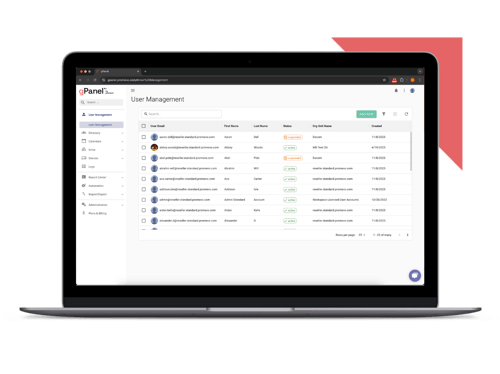
User lifecycle automation anchors this approach. Onboarding and offboarding create some of the highest-risk moments in any environment. Manual steps lead to missed access removal, delayed provisioning, and unnecessary support tickets. Automation eliminates those gaps.
When a user joins, gPanel ensures accounts, Groups, Drive access, and configurations align with policy immediately. When a user leaves, access disappears cleanly. Orphaned accounts stop accumulating. Help desk volume drops.
Granular role-based access strengthens governance without slowing teams down. gPanel allows you to define operational roles that match how work actually happens. You assign responsibilities like onboarding support or vacation responder management without granting full administrative power. Security stays intact while operations move faster.
Visibility completes the picture. Governance fails when teams can’t see what’s happening. gPanel expands reporting beyond native limitations by surfacing patterns that hide across the environment. You track publicly shared documents, external sharing trends, delegated access, and other risk indicators over time. Native logs often cap history at six months. gPanel maintains indefinite visibility, supporting audits, investigations, and long-term optimization.
Rules Engines tie everything together. Custom if-then logic enforces policy automatically. When conditions change, actions follow. Security alignment becomes proactive rather than reactive.
Governance in Practice Delivers Measurable Impact
Governance feels abstract until teams see outcomes. Real organizations use gPanel to translate policy into daily improvement.
Our Trimble case study is a great example. This organization used gPanel to introduce granular role controls and delegation. As a result, Super Admin permission usage dropped significantly. Help desk self-service improved because teams could safely handle routine tasks without escalation. Security strengthened while operational speed increased.
SiLo, for another example, focused on user lifecycle automation. By managing onboarding through gPanel, the team saved thirty to forty minutes per new user. Configuration errors decreased. Consistency improved. Time returned to higher-value work instead of manual cleanup.
These outcomes matter because they compound. Each improvement reduces friction across the environment. Governance stops acting like a constraint and starts acting like an accelerator.
Governance Sets the Stage for Digital Transformation
Digital transformation doesn’t happen through a single deployment. It unfolds through continuous alignment between people, data, and systems.
Governance starts that process by creating stability. Automation builds on that stability by reducing manual effort. Unification connects systems and workflows. Transformation emerges as teams operate with clarity and confidence.
AI initiatives depend on every step in that sequence. Without governance, AI amplifies chaos. With governance, AI amplifies insight.
gPanel plays a role in that journey. It helps you establish a governed foundation that future initiatives can rely on. Organizations don’t need to map the entire transformation upfront. They need to start in the right place.
Continuous Governance Sustains Long-Term Value
Governance doesn’t end once policies exist. Environments evolve. Tools change. Risk profiles shift. Continuous review ensures governance remains aligned with business needs.
Regular visibility into access, sharing, and automation outcomes allows teams to refine policies over time. ROI grows as governance adapts instead of stagnates.
This approach prepares organizations for secure AI deployment. Models rely on trustworthy data. Employees rely on consistent systems. Leaders rely on predictable outcomes. Governance supports all three.
Governance as the First Step Forward
Organizations often underestimate governance because it lacks flash. It doesn’t feel transformative on its own. Yet every successful transformation begins there.
Google Workspace governance shapes how data flows, how people collaborate, and how safely innovation can scale. gPanel turns governance from a static checklist into an active system that supports growth.
Digital transformation becomes achievable when foundations hold. Governance provides that foundation. Everything that follows depends on it.



 User Management
 Group Management
 OU Management
 Gmail Management
 Drive Management
 Calendar Management
 Device Management
 Workspace Reporting
 Workspace Automation
 Billing & License Management


 John Pettit

 John Pettit : Aug 7, 2025, 5:00:00 AM