Managing the employee lifecycle within Google Workspace is a complex and time-consuming task that involves numerous processes like onboarding, offboarding, decommissioning, and delegation — all of which are prone to human error and can pose significant security risks if not handled correctly.
For Google Workspace administrators, automating these processes is essential to improve efficiency, accuracy, and security.
However, automating employee lifecycle management is no easy feat. It requires a solution that can handle the needs of different employee roles, ensure compliance with internal policies, and maintain data integrity and security.
Without the right tools, admins can quickly become overwhelmed by all of the tasks required to manage user accounts and permissions effectively.
This guide will explore how gPanel® can automate and streamline your employee lifecycle management process within Google Workspace. We'll show you how gPanel simplifies the entire process, and provides the perfect framework to reduce errors, save time, and enhance security for your organization.
$4,100 average cost to onboard a single new employee SHRM
$2K–$8K IT-specific onboarding cost per hire in hardware, software licenses, and admin labor Workwize, 2025
30% of new hires leave within their first 90 days, often due to poor onboarding experiences Enboarder / AIHR, 2025
Common Employee Lifecycle Management Challenges
Managing the employee lifecycle has always been a complex process, but with the proliferation of SaaS applications and remote work, these challenges have only intensified.
🔄 Onboarding & Offboarding
One of the most time-consuming tasks for IT departments is the manual onboarding and offboarding of employees. As organizations grow and adopt more SaaS applications, the burden on IT staff increases exponentially. The average company now uses about 130 different SaaS applications, which means manually creating user accounts and assigning permissions can take up an enormous amount of time. The process can be more than a bit tedious, but it's also prone to human error, which can lead to significant issues down the line.
🔐 Role-Based Access Management
Assigning and updating permissions as employees move within the organization presents another significant challenge. Role-based access management is critical for maintaining security and operational efficiency, but it becomes increasingly difficult to manage manually as the number of employees and applications grows. Without a streamlined, automated process, IT departments may struggle to ensure that all users have appropriate access levels at all times. This can lead to security vulnerabilities and inefficiencies, as outdated or incorrect permissions can hinder productivity or expose sensitive data.
🛡️ Data Security
Data security is a paramount concern, especially when employees leave the organization. Making sure that all sensitive data is securely transferred and that access is promptly revoked is crucial for protecting company information. However, this process is often mishandled, creating potential security risks. If an ex-employee retains access to company applications, they could potentially misuse sensitive information or disrupt operations. Automating the offboarding process can mitigate these risks by making sure that all access permissions are revoked immediately and that any critical data is properly transferred to the appropriate personnel.
🔀 Mid-Lifecycle Changes
Mid-lifecycle changes, such as promotions or departmental transfers, add another layer of complexity. These changes necessitate updates to user permissions and access levels, and managing these updates manually can be both time-consuming and error-prone. IT departments must guarantee that these changes are reflected across all relevant applications and systems, which can be a daunting task without automation. Failure to do so can lead to operational inefficiencies and security risks, as users may either lose access to necessary tools or retain access to systems they no longer need.
The Benefits of Automated Employee Lifecycle Management
Manual processes are inherently prone to human error. Whether it's a typo in an email address, incorrect permission settings, or missed steps in offboarding, these errors can lead to operational inefficiencies and security vulnerabilities.
Automated employee lifecycle management eliminates these risks by standardizing and automating repetitive tasks. When user accounts are created, permissions assigned, or access revoked automatically, the chances of errors drop dramatically.
Another benefit is time — one of the most valuable resources for any organization. Automating employee lifecycle management can save a significant amount of time by handling routine tasks that would otherwise require manual intervention.
For example, onboarding a new hire traditionally involves setting up multiple accounts and permissions across various SaaS applications. With automation, this process can be completed in a few clicks, freeing up IT staff to focus on more strategic initiatives.
Security is another concern in today's workplace, and automated employee lifecycle management offers robust solutions to enhance it. When an employee leaves the company, it's vital to revoke all access immediately to prevent unauthorized data access. Automated workflows ensure that offboarding is handled seamlessly, closing all potential security loopholes.
gPanel & Automated Employee Lifecycle Management
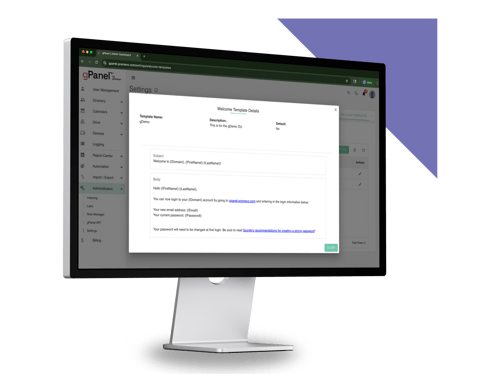
gPanel by Promevo offers a comprehensive solution for automating and streamlining employee lifecycle management within Google Workspace.
👤 Onboarding
gPanel allows administrators to quickly add new users and assign them to the appropriate organizational units and groups. All of this can be done in just a few clicks, significantly reducing the time and effort required to get new employees up and running.
🚪 Offboarding Policies
Administrators can create customized offboarding policies that automate a series of actions, such as resetting passwords, transferring calendars and documents, and ultimately deleting the user account. These policies can be tailored to different types of employees, whether they are seasonal staff, contractors, or full-time employees, allowing for a high degree of flexibility.
📦 Decommissioning
gPanel provides tools to set up decommissioning policies so administrators can assign specific actions to user accounts, such as delegating email access or transferring documents, ensuring no data is lost and responsibilities are appropriately reassigned.
🎯 Delegation & Role Changes
Administrators can create custom user or admin roles with specific permissions, so that access to critical resources is controlled and monitored. This is particularly helpful when employees change roles within the organization, as their permissions can be updated automatically to reflect their new responsibilities.
What a gPanel Offboarding Policy Actually Does
When an admin triggers an offboarding policy in gPanel, the platform executes a structured sequence of actions automatically — no manual steps, no missed permissions. Here's what that looks like in practice:
1
Password reset & sign-out
The departing user's password is immediately reset and all active sessions are terminated across Google Workspace, Gmail, Drive, and connected apps.
SECURITY
2
Drive & calendar transfer
Owned files and calendar events are transferred to a designated manager or team member. No data orphaned, no access to hunt down later.
DATA INTEGRITY
3
Email delegation or forwarding
Incoming mail is forwarded or the inbox is delegated to the appropriate contact for a defined period, keeping communications intact during transition.
CONTINUITY
4
Group & OU removal
The user is removed from all Google Groups and organizational units, immediately closing access to shared resources and distribution lists.
ACCESS CONTROL
5
Account suspension or deletion
Depending on your policy, the account is suspended for a retention period and then deleted (or deleted immediately). License is reclaimed automatically.
COMPLIANCE
Each step is logged in full, giving admins a complete audit trail for security reviews or compliance requests without a single manual entry.
Get Started With gPanel
Automating your employee lifecycle management is no longer a luxury but a necessity in our fast-paced, SaaS-driven work environment. With gPanel, Promevo offers the ideal solution tailored for Google Workspace administrators, with seamless onboarding, offboarding, and role management.
If you're ready to take the headaches out of employee lifecycle management, schedule a gPanel demo and experience the power of automation firsthand.


 User Management
 Group Management
 OU Management
 Gmail Management
 Drive Management
 Calendar Management
 Device Management
 Workspace Reporting
 Workspace Automation
 Billing & License Management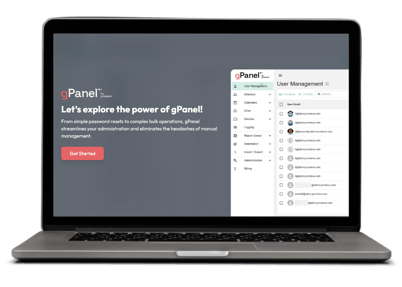


 John Pettit

 John Pettit : Nov 24, 2023, 5:00:00 AM