 User Management
 Group Management
 OU Management
 Gmail Management
 Drive Management
 Calendar Management
 Device Management
 Workspace Reporting
 Workspace Automation
 Billing & License Management

How to Manage Google Workspace for Multiple Domains
 John Pettit : Apr 3, 2025, 5:00:00 AM
Efficiently manage multiple domains in Google Workspace, ensuring streamlined operations, enhanced security, and compliance.


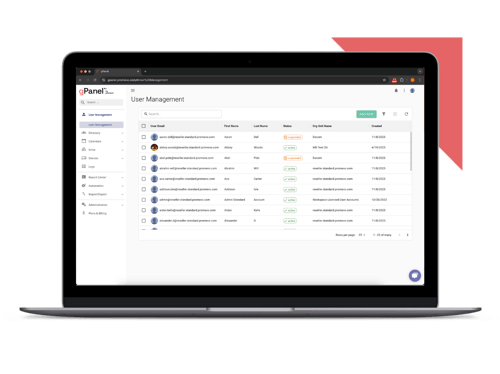
Simplify Google Workspace management with our most essential tools for user and email administration.
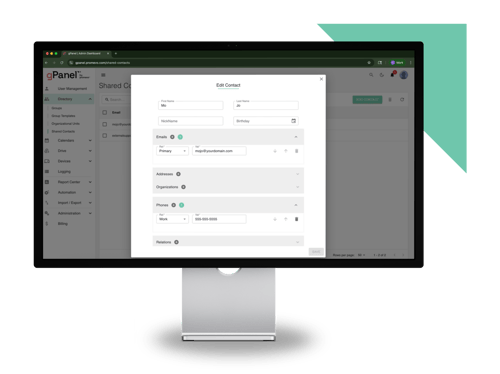
Unlock powerful automation, bulk actions, and reporting features to streamline and scale your admin workflows.
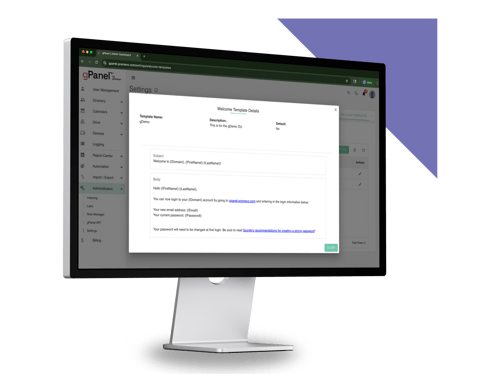
Take full control of your domain with advanced policies, APIs, and security tools built for large or complex environments.
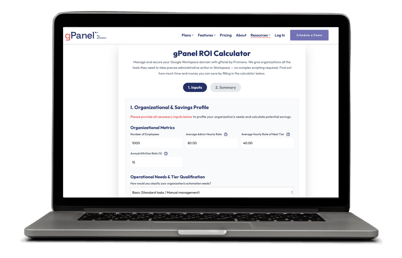

Managing Google Workspace can feel like a never-ending loop.
One minute you’re resetting a password. The next you’re transferring Drive ownership after an offboarding. Then someone asks for a new signature policy, and you’re bouncing between user accounts trying to make it happen.
It’s not glamorous. It’s not strategic. And it’s definitely not scalable.
Manual admin work in Google Workspace eats up time, introduces risk, and holds your IT team back from doing the work that actually moves your business forward.
So what’s the real cost? Time. Money. Missed opportunities. And a whole lot of hidden burnout.
This breakdown will show you how quickly manual tasks pile up — and how Google Workspace automation platforms like gPanel change the game.
Manual tasks feel small in the moment, but they stack fast. These are the usual suspects that quietly eat your week.
You create accounts, assign licenses, set access, create groups, transfer files, update calendars, and double-check it all. Every time someone joins or leaves, you’re pulled into a half-hour of tasks.
Email is business-critical. Miss a step during delegation or fail to forward correctly, and you’re looking at delays or security risks.
If someone leaves the company or switches teams, you need to hand off calendar access to avoid dropped meetings and siloed info.
When someone changes roles or exits, you need to make sure they’re not walking away with sensitive documents or leaving data inaccessible to other team members.
Brand consistency matters, but updating every user’s Gmail signature manually is a slow, thankless loop.
Shifting users between departments or permissions requires attention to detail — and multiple steps you can’t skip.
These tasks aren’t rare. They happen daily. The more your org grows, the more time you lose.
Let’s run the numbers.
Take a mid-sized company with 250 users. Each month, you bring on three new hires and offboard three employees. You also handle about five admin requests per day — plus regular file, calendar, and signature maintenance.
Now let’s break down how long this actually takes:
Conservative estimate: 30–35 hours per month.
That’s nearly one full-time week of manual work — every single month.
In a year, that’s 360+ hours just on repetitive tasks. Not planning. Not innovating. Not improving security. Just keeping the wheels turning.
Time loss is easy to measure. But the real damage runs deeper.
Miss a calendar transfer? Forget to revoke file access? These aren’t just slip-ups. They’re security and compliance risks.
If your new hire spends the first two days without email or Google Drive access, they’re stalled. Same goes for employees waiting on shared folders or calendar links.
When your IT team spends all day doing manual busywork, morale tanks. They don’t have time to build systems — they’re too busy patching them.
Fixing Gmail signatures or setting up forwarding rules takes time away from bigger initiatives:
Every minute on a manual task is a minute lost on something better.
Let’s zoom out. That 30–35 hours/month isn’t static — it grows with your company.
Say your team doubles in size to 500 users. That means:
You’re now looking at 60–80 hours/month of manual overhead. That’s two full weeks of work that could be automated — or two employees worth of time stuck on repeat tasks.
Without automation, your IT team becomes a bottleneck. You can’t scale your org without scaling your systems.
Automation doesn’t replace your IT team. It gives them their time back.
gPanel exists for this exact reason: to eliminate the slow, error-prone manual work that Google Admin console doesn’t cover well.
Here’s how it works.
Use templates to assign roles, licenses, group memberships, and email policies. When someone leaves, automate file transfers, calendar ownership, vacation responders, and deactivation — all from one place.
Stop chasing down who has access to what. Set policies that adjust based on role, org unit, or department — no manual audits required.
Update Gmail signatures across the company in one click. Set delegation and forwarding rules without logging into individual accounts.
Make mass updates without scripts or spreadsheets. gPanel lets you handle hundreds of users or groups at once — in a few clicks.
The difference shows up fast. Instead of scrambling to clean up messes, your team can focus on higher-level work that supports real growth.
Google Admin gives you the basics — but only gPanel closes the gaps.
If you’ve ever tried to offboard someone in Google Admin, you know it’s clunky. There’s no bulk automation. No custom templates. No policies that adapt based on your org chart or team structure.
With gPanel, you can:
Google Admin wasn’t designed to handle scale. gPanel was.
The truth is, you already pay for manual admin work. You pay with time, money, and risk.
You pay in lost productivity when a new hire doesn’t get access on Day One. You pay when an offboarded employee still has Drive access after 30 days. You pay when your IT team burns out managing menial requests instead of innovating.
And those costs only grow as your org scales.
gPanel automates the work Google Admin doesn’t. It gives you control, consistency, and confidence — without draining your team.
Ready to see what that looks like? Request a gPanel demo today.

 John Pettit : Apr 3, 2025, 5:00:00 AM
Efficiently manage multiple domains in Google Workspace, ensuring streamlined operations, enhanced security, and compliance.
 John Pettit : Jan 16, 2025, 5:00:00 AM
Enhance your Google Workspace admin workflows with five practical strategies to boost productivity, streamline processes, and achieve maximum...
 John Pettit : Sep 18, 2025, 5:00:00 AM
Learn how to build a robust IT incident response plan for Google Workspace by defining roles and leveraging tools like gPanel to act decisively.