The new gPanel API expansion isn't just a feature update. It's a signal that gPanel is becoming something even more beneficial — a governed, auditable control layer for your entire Google Workspace environment.
Sometimes it can feel like managing Google Workspace at scale is an oxymoron.
The Google Admin Console covers the basics, but it was built for clicking, not for efficiency. GAM (Google Apps Manager) gives you command-line power, but it's untracked, unlogged, and requires technical know-how that most admin teams don't have on hand. Custom scripts fill the gaps, but they drift, break, and leave no audit trail.
Not to brag, but gPanel users have enjoyed the luxuries of automation, action logging, and audit trails for a while. With recent updates to our APIs, gPanel users can now use the platform for a full operational control layer.
We've added over 210 new endpoints, organized across six operational pillars, to give you structured, auditable execution of advanced administrative actions without the risk of unmanaged scripts or the limits of the Admin Console.
The Six Pillars at a Glance
🔑 Identity & Access Users, groups, OUs, aliases, admin roles, domains
🛡️ Security & Compliance 2SV, audit logs, email monitoring, Drive activity
📁 Collaboration & Data Shared Drives, permissions, file search, revisions
✉️ Communication Gmail labels, filters, forwarding, S/MIME, vacation responders
💻 Device Control MDM, ChromeOS lifecycle, remote wipe & powerwash
⚙️ Lifecycle Automation Bulk provisioning, OU sync, group sync, data transfers
How gPanel Compares to Your Other Options
Before this release, most Workspace admins were working with three tools in parallel: the Admin Console for basic UI tasks, GAM for scripted bulk actions, and some combination of internal scripts or third-party tools for everything else.
Here's how that picture changes with gPanel's expanded API coverage.
| Capability |
Google Admin Console |
GAM / Manual Scripts |
gPanel |
| Bulk user provisioning |
⚠ CSV import only |
⚠ Possible, no audit trail |
✔ Structured, logged, auditable |
| Custom admin role management |
⚠ UI only, no automation |
✘ Limited support |
✔ Create, assign, retrieve via API |
| Bulk Drive permission changes (ACLs) |
✘ Not available |
⚠ Scripted, fragile |
✔ Full ACL management at scale |
| Gmail filter & label management |
✘ Per-user only |
⚠ Scriptable, no governance |
✔ Create/delete across users, centrally |
| Enforce 2SV & retrieve backup codes |
⚠ Policy toggle only |
⚠ Partial support |
✔ Enforce, retrieve status, retrieve codes |
| Remote wipe / ChromeOS powerwash |
⚠ Manual, per-device |
⚠ Command-line, untracked |
✔ Issue & confirm commands from gPanel |
| Data transfers (Drive, Calendar, Looker Studio) |
⚠ Manual initiation only |
✘ Not supported |
✔ Create, monitor, and retrieve transfers |
| Audit log access (Drive, Gmail, admin) |
⚠ UI only, limited export |
⚠ Possible but complex |
✔ Structured retrieval across all activity types |
| OU and group synchronization |
✘ Manual only |
⚠ Scripted, no orchestration |
✔ Automated sync with full endpoint coverage |
| All actions authenticated and logged |
✘ Partial |
✘ No |
✔ Always; every action |
Why this matters for compliance: Every Google Workspace action executed through gPanel is authenticated, logged, and auditable. When your security team or an auditor asks "who changed what, and when?" you'll have the answer, without stitching together Admin Console exports and guessing about GAM commands run six months ago.
Real Scenarios These APIs Unlock
If you've read this far you probably understand how to put the new API endpoints in action. These aren't hypothetical edge cases; they're the kind of situations most mid-size and enterprise Workspace admins deal with regularly.
Scenario 1: Employee offboarding at scale
When an employee leaves, there are typically a dozen steps that need to happen at once: set a vacation responder, configure forwarding to their manager, delegate mailbox access, and transfer their Google Drive, Google Calendar, and Looker Studio assets to the right owner. Previously, this was a checklist of manual steps, or a script that someone wrote in 2014. The new lifecycle automation APIs let you execute all of this as an orchestrated workflow, with every step logged.
Google Drive Google Calendar Looker Studio Gmail
Scenario 2: Remediating over-shared files in Google Drive
A devious employee shares a sensitive document with "anyone with the link" and it makes its way into the public sphere. Or you use a gPanel Google Drive Sharing report to discover many broadly shared files. With the new Collaboration & Data APIs, you can run an advanced file search filtered by sharing visibility, then execute bulk ACL changes across Shared Drives all from gPanel, without spinning up a custom script. Many organizations pay for tools that essentially do primarily this function in Google Workspace; it's one of hundreds of Google Workspace management functions in gPanel.
Google Drive Shared Drives
Scenario 3: High-volume provisioning for a new school year or company merger
Whether you're a school district enrolling a new class of students, a managed service provider (MSP) spinning up a new client environment, or an enterprise integrating an acquired company's staff, bulk provisioning is one of the most time-consuming Workspace tasks. The new lifecycle APIs let you create and update users, groups, and aliases in bulk, assign them to the right OUs, and set up calendar resources—all in a single, auditable run. Import a roster from your HRIS or SIS, map the fields, and execute.
Workday BambooHR PowerSchool
Scenario 4: Proving compliance before an audit
Your security team needs to demonstrate that 2-step verification is enforced across your organization, that no unauthorized admin roles exist, and that there's a complete activity log of admin and Gmail actions over the past 90 days. With the Security & Compliance APIs, you can retrieve 2SV/2FA status across users, pull all current admin role assignments, and access structured audit logs for admin activity, login events, Drive actions, and Gmail. All without logging into multiple places and exporting CSVs by hand.
Admin audit logs Drive activity logs Gmail activity logs
Scenario 5: Responding to a lost or stolen device
A Chromebook goes missing at a remote office. Previously, finding the device, verifying its state, and issuing a remote wipe involved multiple steps across the Admin Console, possibly a call to IT (eww!), and no reliable confirmation that the command was received. The new Device Control APIs let you retrieve the device's current state, issue a powerwash command, and confirm execution; all from within gPanel, logged to your audit trail.
ChromeOS MDM
This Is Foundational Infrastructure
This is bigger than a UI refresh or a handful of new features. It's the operational foundation that makes everything else possible: workflow orchestration, AI-driven administration, integrations with your HRIS (Rippling, BambooHR, Gusto, Workday, etc.), CRM (HubSpot, Salesforce.com, Oracle, etc.), and ERP systems (NetSuite, Infor, SAP S/4HANA, etc.). You can't build those things on top of a limited API surface. This expansion creates that surface.
If you're already using gPanel Enterprise, you now have programmatic access to a much deeper set of controls and every one of them is authenticated, logged, and auditable out of the box.
If you're still relying on GAM scripts or manual Admin Console workflows for critical operations, this is a good moment to evaluate whether those tools were ever designed for what you're asking them to do.
Google Workspace gives you the collaboration platform. gPanel gives you the control layer to run it at scale.



 User Management
 Group Management
 OU Management
 Gmail Management
 Drive Management
 Calendar Management
 Device Management
 Workspace Reporting
 Workspace Automation
 Billing & License Management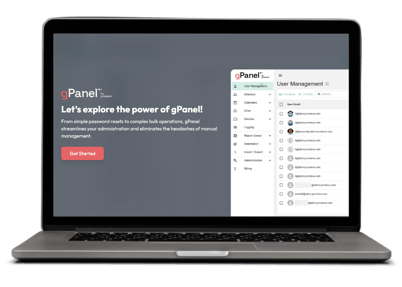


 Brandon Carter

 Christine Page : Aug 24, 2023, 5:00:00 AM

 Brandon Carter
 Colin McCarthy