Google Workspace security depends on more than strong passwords and two-factor authentication. Access control plays an equally critical role. Every admin decision about permissions shapes the security posture of the entire organization.
The Principle of Least Privilege (PoLP) sits at the center of modern access management. The idea sounds simple: give people the minimum access required to do their job. In practice, many organizations drift far away from that model.
Large Google Workspace environments often accumulate excessive permissions over time. Temporary admin roles never get removed, and IT teams share high-level access for convenience. Each extra permission increases your risk profile.
Promevo Security Insights
A well-designed least privilege strategy reduces the impact of compromised accounts, insider mistakes, and administrative errors. Google Workspace® provides the foundation to implement this model. Tools like gPanel® make it much easier to maintain over time.
This guide walks through how PoLP works in a Google Workspace environment and how your organization can apply it effectively.
What the Principle of Least Privilege Means Today
The Principle of Least Privilege defines a security model where users, services, and systems receive only the access required to complete a specific task. Nothing more.
01
Minimum access level required to complete the task
02
Minimum time window during which access exists
Once the task ends, the privilege disappears. Many IT teams misunderstand the goal. Least privilege does not signal distrust of employees or administrators. The goal focuses on risk containment. Think of it as reducing the blast radius of a compromised account.
If an attacker gains control of an over-privileged account, they gain the same access the account holds. Broad permissions allow attackers to move laterally, escalate privileges, and access sensitive data. Tight privilege boundaries limit how far the damage spreads.
The Over-Privileged Reality in Many Google Workspace Environments
Many Google Workspace deployments evolve into what security teams call an over-privileged environment. Common patterns include:
- Every IT staff member holds Super Admin rights
- Shared admin credentials circulate within teams
- Admin accounts double as everyday email accounts
- Temporary access permissions remain active indefinitely
An organization with 10 Super Admins effectively runs 10 keys to the entire kingdom. Least privilege reverses that pattern by creating tightly scoped access roles that align with specific responsibilities.
Understanding the Google Workspace Permission Hierarchy
Google Workspace permissions operate across several layers. Effective implementation requires using these layers together rather than relying on a single control.
01
Organizational Units (OUs)
Segment users into logical groups. A strong model organizes OUs around access requirements like contractors or privileged IT staff.
Learn more
02
Admin Roles
Use system-defined roles or custom roles to match privileges precisely to responsibilities, such as password resets only.
Learn more
03
Groups-Based Access
Assign permissions to groups rather than individuals. This simplifies onboarding and ensures consistent permission assignment.
Learn more
Practical Steps to Implement Least Privilege
The process becomes much easier when broken into clear operational steps.
Audit Your Current Privileged Access
Start by identifying every account that holds elevated permissions. Google Workspace provides reporting tools that reveal which users hold roles like Super Admin, Groups Admin, or Security Admin. Many teams discover far more privileged accounts than expected.
Create Purpose-Built Custom Roles
Custom roles allow you to replace broad admin privileges with precise permissions. Use the table below to see how roles should be segmented:
| Role Name |
Primary Function |
| Password Support Admin |
Reset passwords & unlock accounts |
| Group Manager |
Manage group membership only |
| User Provisioning Admin |
Create and suspend accounts |
| Device Manager |
Manage endpoint policies |
Introduce Just-in-Time (JIT) Privileges
Least privilege works best when elevated access exists only when required. Just-in-Time access provides temporary privilege elevation for specific tasks. Even short-lived admin access dramatically reduces exposure compared to permanent elevated permissions.
The "Dual-Account" Strategy
"Super Admins should never use their privileged accounts for daily activities like responding to email, attending meetings, or editing documents."
Google Security Best Practices, Official Documentation
Instead, each admin should use a Super Admin Account for high-level tasks and a Standard User Account for all day-to-day work. This ensures that highly privileged credentials are only exposed when absolutely necessary.
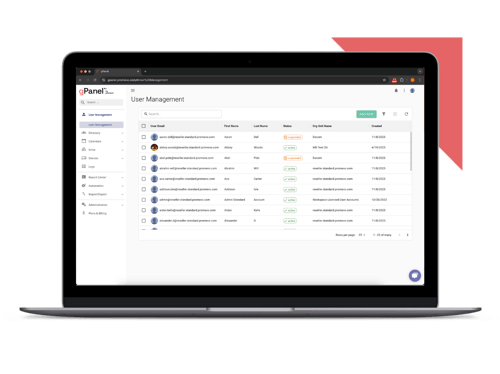
Using gPanel to Enforce Least Privilege at Scale
Google Workspace provides the building blocks, but gPanel adds the operational control needed for large environments.
- Granular Delegated Administration: Create extremely specific delegated permissions that align with operational responsibilities.
- Automated Offboarding: Create custom workflows to ensure privileges disappear immediately when a user leaves the company.
- Continuous Visibility: Use gPanel reporting tools to monitor privileged account usage and spot unusual patterns.
As organizations expand their Google Workspace environments, least privilege becomes one of the most effective ways to strengthen security without slowing productivity.




 User Management
 Group Management
 OU Management
 Gmail Management
 Drive Management
 Calendar Management
 Device Management
 Workspace Reporting
 Workspace Automation
 Billing & License Management


 Colin McCarthy

 Brandon Carter : Aug 15, 2023, 5:00:00 AM